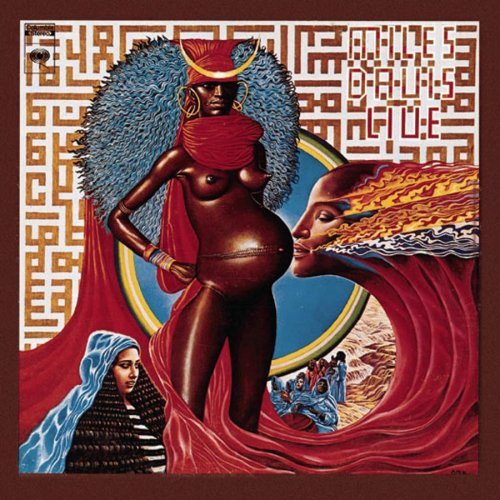
Ah, innocence lost. What a great theme for a hard rock/metal band album cover. A smoking angel is a hilarious contradiction, working with the fallen angel idea on a number of different levels. Dio-era Black Sabbath devised of this idea first for their 1980 album, appropriately titled Heaven and Hell. This was the first album they released after Ozzy was booted from the band, and was a re-birth for them in a number of ways. With Dio's huge, epic pipes blowing Ozzy's nasal whine out of the water, the band speeds their trademark sludgy riffs into a faster, more energized metal that just kills it. Highly recommended.
It couldn't be a coincidence that Van Halen used this idea only four years later for their last David Lee Roth-era album. They do improve upon the concept with a fantastic smirking, impish Cupid-cherub illustration (a play on the classic Raphael painting), though the concept couldn't have been original after Sabbath used it. Regardless, 1984 sold 10 million copies, so most of you reading this knows this cover well, and have probably never seen the Sabbath one.
This one is pretty self-explanatory. While the past few posts have been more thematically similar, this one couldn't be any more literal: asteroids falling to earth near a lake at twilight, leaving a brilliant trail in their wake. Bam! 70's album cover gold. The image just has a certain je ne sais quoi that whispers class in just the right way...
These albums were released within two years of each other in the mid-70s. Many are familiar with Weather Report, the hugely successful and ground-breaking jazz fusion group, but the band Firefall has been lost to time, probably for good reason. They're the ones who contributed this little ditty to civilization:
You know you've heard it, the melody is definitely back there in your subconscious somewhere. Most likely it was playing while you were shopping for groceries, or browsing the aisles for slacks at Marshalls. The song fits the department store soundtrack criteria perfectly: non-threatening, bland, unobtrusive, and pleasantly innocuous. Firefall has found a lasting place in society right next to Sade's "Smooth Operator," serenading shoppers around the world into a relaxed anesthesia. I wonder if they get royalties for it.
The gorgeous Old West/Norman Rockwell theme of a bonneted, skirt-billowing dame gazing longingly in the distance isn't the only similarity in these two excellent albums. Both these bands emerged out of Bill Graham's ballroom-circuit San Francisco in the late 60s, which produced more than its fair share of amazing music.
While many know of Quicksilver and their virtuoso lead guitarist John Cipollina, fewer have heard of the progressive rock band It's A Beautiful Day, which was a Bay Area staple for a number of years during those halcyon days. During the late 60s, those crazy Frisco hippies developed a widespread cultural obsession with the Old West that permeated their fashion, art, and music. It also made for some righteous album covers. Thanks, hippies, for your awesome contribution to pop culture.
This week we feature two albums from the late 1950s. Both are seminal recordings of the most important and influential black artists of a generation, and both feature white females on their covers. What's wrong with this picture?
It seems that in pre-Civil Rights era America, it was pretty tough to get http://www.blogger.com/img/blank.gifthe general white music-listening audience to turn an ear to the "race records" of the time. The solution to this problem was to put pretty young whites on the covers of such records, thus attracting a wider audience of deluded whites, and prompting Miles Davis to ask Columbia Records executive George Avakian "Why'd you put that white bitch on there?" Things soon got better, and subsequent re-releases saw the album covers changed to better reflect the music that was inside. In the following years, Miles and JB were eventually granted creative freedom over their album art, which yielded colorfulresults. Shit's crazy, though.
Ah, the golden age of vinyl. It was only during this time -- approx. from 1969-1983 -- that the packaging of records became a real art form, resulting in a product in which the record sleeve's design and art was given as much attention as the music inside (an art form that is all but lost in today's digital industry).
Many record covers in the 70s omitted the traditional glossy shine, opting for a softer, natural cardboard texture, which the grainy, saturated, shadowy-cheekbone photos in these examples compliment nicely. Of course, these .jpegs don't give any sense of the album's texture, which can only be experienced by lovingly holding, cradling and caressing the record in your hands. So head to your local vinyl shop and rub your hands over some classic records, as these are examples of timeless album art for the ages.
This week starts a new reoccurring segment, in which two existing album covers are picked from time and space and presented as coincidentally similar.
Today's pair both seem to be freaked out that their hands have morphed into unwieldy electronic equipment. The main difference here being that one is a landmark album in the history of hard rock, and the other is a ridiculous, awful joke of a record. Guess which is which?
I hope everyone out there in the land of the internets had a grand 4th of July weekend, preferably spent far, far away from any computers or wi-fi connections. I had one for the record books: four days of camping and music up at the High Sierra Music Festival in Plumas County, high in the mountains. There was non-stop music from 10am to 4am, four days in a row, and I did my darndest to catch as much as I could. It is truly the most well-put together festie I've ever attended, and I would recommend it to any music lover. Here's my writeup of the long, exhausting, exhilarating weekend over at Jambase, supplemented with tons of awesome pics:
The Travelin' McCourys pickin' up a storm among the pines:
Brokedown in Bakersfield was a one-gig-only country band put together to play High Sierra, and they certainly didn't disappoint:
Reggae guitar legend Ernest Ranglin got us all skanking with an epic sunset set. Here Audio Angel helps him out on a cover of The Abyssinians' "Satta Massagana":
Later that night, Ween got us all brown with Skerik on sax for "Your Party":
Gillian Welch closed out her set on the first night with a huge take on "White Rabbit":
Heyo! Got another half hour to kill? Great! This week's installment of Criminally Underrated Guitar Gods focuses on the more proggy/fusion style players that have fallen by the wayside of widespread recognition. Prepare to have your face melted by some serious fretwork, and you may learn a thing or two in the process...
Jeff Beck Having graduated from the same school of British blues-rock as Clapton and Page (all three played in the Yardbirds at one point, Page and Beck together for a time), Jeff Beck seemed to be the black sheep of this graduating class. While his chops were on par with his soon-to-be-more-famous cohorts, Beck's musical vision proved to be less accessible than his peers. Beck never strove for the bombast and arena-rock showmanship on the caliber of Cream or Zeppelin, and instead carved out his own legacy of instrumental music, churning out quality albums of blues-rock and jazz fusion over the years. He did score a couple of platinum albums in the mid-70s (back when the public actually listened to jazz fusion), but fell out of the mainstream eye in the ensuing years. His unique playing style (vibrato bar, no pick, finger tapping, etc) is instantly recognizable, and is known to pull sounds out of a guitar that boggle the mind. It's reassuring that Beck has had a resurgence in recent years thanks to a new-found musical relationship with Clapton. He is a true virtuoso, and deserves all the praise he can get.
Jeff Beck - "Scatterbrain"
Terry Kath Kath was the lead guitarist of The Chicago Transit Authority (soon shortened to just "Chicago") from 1968 until his death at 32 in 1978. His amazing talents were often obscured by Chicago's big-band format, which had a large horn section often taking the lead. Despite this, Kath managed to attract the attention of Jimi Hendrix, who once told Chicago saxophonist Walter Parazaider, "Your guitar player is better than me." Kath struggled with addiction and weight problems throughout the 70s, and has perhaps the most tragic death on this list. Kath was playing around with a supposedly unloaded pistol at a party, and put it to his temple and pulled the trigger. There was a bullet in the chamber, and Kath died instantly. His solo on "25 or 6 to 4," from Chicago's second album, is legendary:
Chicago - "25 or 6 to 4"
Steve Howe Howe has seen his share of mainstream success as lead guitarist of Yes, and also had a stint with Asia in the early 80's. Yes was a giant in the music world through the 70s, and Asia scored a few pop MTV hits in the 80s, though few actually know Howe by name, and few know that he is equally remarkable on classical guitar as he is on electric. Prog rock has garnered an ugly reputation since its peak of decadence around 1974, and Yes has lost much of its street cred since, save for a rabid cult following that it maintains to this day. Howe still tours with Yes regularly, and with all his chops intact, taboot -- his otherworldly technical mastery is second to none. His acoustic skills warrant their own track, on top of some classic electric Yes freakout-rock:
Yes - "Mood For A Day" Yes - "Sound Chaser"
Robert Fripp Fripp founded King Crimson in 1969, and proved to be the only consistent member of the group, which saw drastic musical and stylistic shifts over its long history. He pioneered prog rock and heavy metal with his dissonant stylings and heavy riffage, and later dabbled in electronic soundscapes with Brian Eno, on top of many, many other side projects. What's notable about Fripp is that his guitar style takes nothing from the blues-based tradition, instead containing more of a European avant-guarde/classical influence. His music is certainly not accessible in any sense of the word, nor is it meant to be. Fripp has consistently challenged the ears of his fans over his long career, though he never ceases to amaze with the weirdness he conjures up with six strings. Case in point? The searing shards of sound he lays down on this Brian Eno track:
Brian Eno - "Baby's On Fire"
Ritchie Blackmore The lead guitarist for Deep Purple from 1968-75, Blackmore was a master of the hard rock riff, having written one of the most recognizable riffs in the history of rock ("Smoke on the Water"). Though this alone should be enough to cement his legacy, it doesn't scratch the surface of what he was capable of with a guitar. After quitting Deep Purple, he formed the since-forgotten band Rainbow, his own project which featured Ronnie James Dio on lead vocals for a time. Rainbow became legendary for its epic live performances, and with Blackmore's lightning-fast fingers at the hem, they crushed audiences night after night. He retired from hard rock in the 90s, and now plays exclusively folk music. Blackmore also warrants two tracks to show his prowess both in the studio and live. His flawlessly executed solo at 3:50 of "Highway Star" is one of the greatest ever laid on wax, while the live Rainbow track is sprawling in its messy virtuosity. Both are awesome, in completely different ways.
Deep Purple - "Highway Star"
Rainbow - "Catch the Rainbow"
Frank Zappa While most know him for his crude humor and absurdly challenging compositions, Frank Zappa was also an absolute monster on the electric guitar. No one has or ever will play the six-string anything like he did, as he brought his own twisted musical sense to every guitar lick he ever played. When improvising, Frank attempted to create spontaneous compositions with his solos. No one ever knew what he would play next, and he set his band up so that they would respond to what he played. This often resulted in new "songs" being created on the spot. The results were often bizarre and avant-garde, and sometimes sublime. I would recommend picking up the 3-disc set Shut Up 'N Play Yer Guitar for more on this technique, which is comprised solely of live guitar solos. As with the rest of his music, his guitar work exists in its own musical universe, free of influence from nothing but the genius in his own head (and maybe some Stravinsky).
Frank Zappa - "Easy Meat"
Is this list to your liking? Do you notice any glaring omissions? Feel free to comment...



 Posts
Posts